
By capability
Concurrent employment
In Capstan a person and an employment are two different records. The person is kept for good; an employment is one stint, with its own employee code, join date, engagement type and status. Because they are separate, one person can hold more than one employment at once, a second concurrent role or contract alongside the first, with exactly one stint marked primary. Seat billing stays person-based, so a concurrently employed person is one seat, not two.
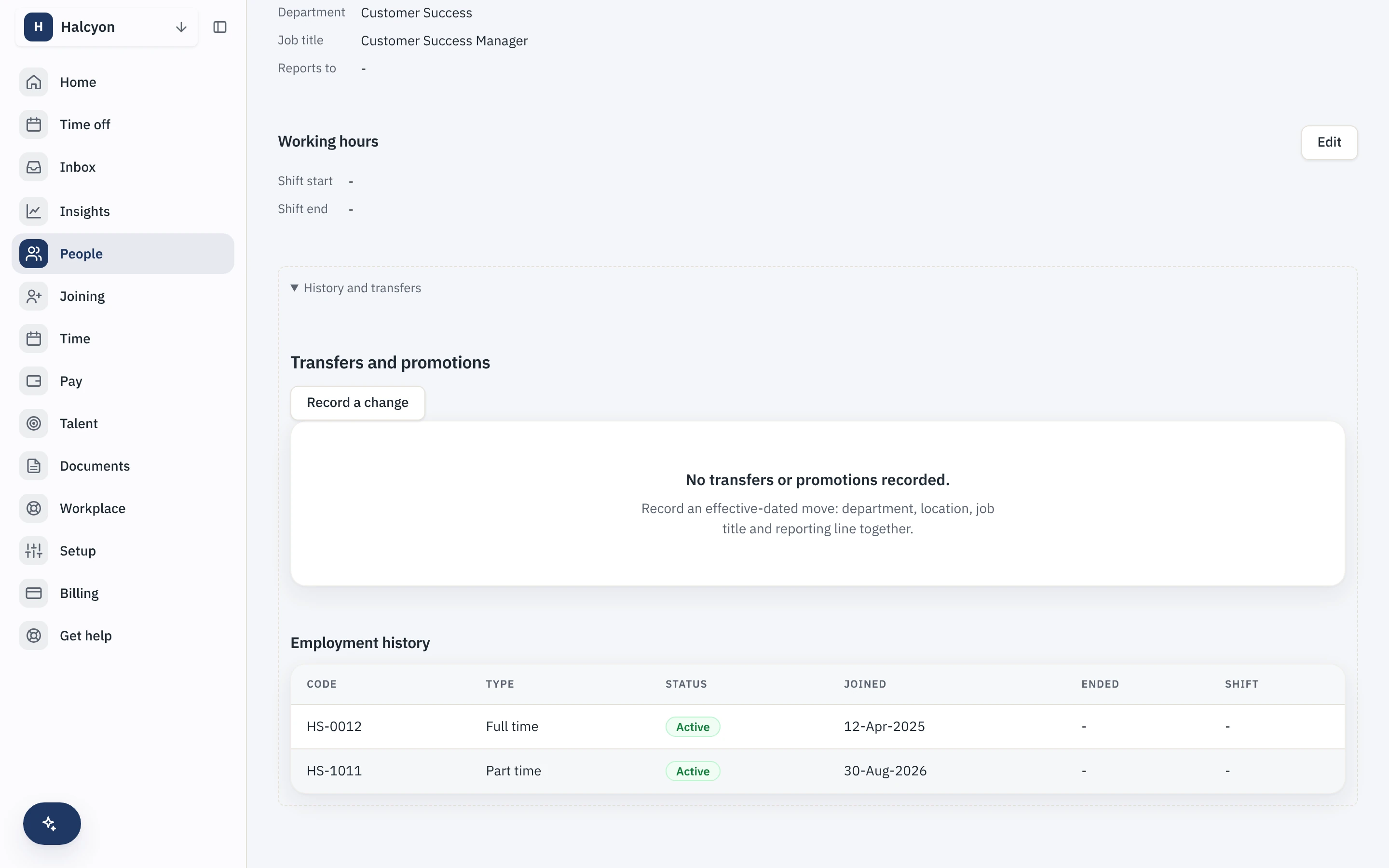
A real capture from the demo workspace, a person with two live stints. Prices sit on the pricing page and nowhere else.
One person, two live stints
The employment history on a person's record lists every stint they hold, the concurrent ones together, each with its own code, dates and status, and the one marked primary.
What is concurrent employment?
Concurrent employment is one person holding more than one active employment at the same time: two roles, two contracts, or a second engagement with a different entity, running together rather than one after the other. It is common on global teams and in India, where a person may carry a second concurrent engagement, and it is the case a single current role per person cannot represent. Capstan models the person once and each engagement as its own stint, so the second role is a record in its own right, not an overwrite of the first.
- The person is one record, kept for good; each employment is a separate stint.
- More than one stint can be active at once, with exactly one marked primary.
- Each stint carries its own employee code, join date, engagement type and status.
Does a second concurrent role cost a second seat?
No. Seat counting is person-based, so a person who holds two concurrent stints is one seat, not two. The free allowance up to twenty active people counts distinct people, and the paid plan bills the roster of distinct people, so a concurrent second stint never adds a seat. That is a deliberate property of the model, not a billing promotion, and it holds however many stints a person carries.
- One person is one seat, whatever number of concurrent stints they hold.
- The free twenty count active people, and a paid plan bills distinct people.
- How seats and the roster are counted is on the docs page, and prices are on the pricing page.
What about rehires and history?
Because the person outlives any one stint, a leaver who comes back is the same person with a new stint, not a duplicate record. The new stint starts clean: its leave ledger and attendance begin empty rather than inheriting the previous engagement. A person's history can be non-contiguous, a stint, a gap, then another stint, or two stints that overlap, and the record holds all of it. Reporting lines point at a stint rather than at the person, so who someone reports to can differ by role.
- A rehire is a new stint on the same person, with an empty leave ledger and attendance.
- History can be non-contiguous: sequential stints, a gap, or overlapping concurrent ones.
- Reporting lines attach to a stint, so a person's two roles can report to different managers.
Is this on every plan?
Yes. The person and employment model is part of the core, so it is on the free plan and a paid plan alike, with no module to turn on for it. A paid plan lifts only the twenty-active-employee cap and changes nothing about how people and stints work. The whole product is on the product page, and the model sits alongside employee self-service and the rest of the core.
- On every plan, because the shape of an employment record is not a feature to sell.
- Built for teams that span countries: see global teams and HR software for India.
- The record model in detail is on the docs page.
Start free for up to twenty people, and keep one record per person however many roles they hold.